Getting Started with PauliwordOp
The Pauli spin matrices \(\{X, Y, Z, I \}\) are defined as:
A Pauli operator \(P_{i}\) is defined as an \(n\)-fold tensor products of such single qubit Pauli matrices. We can write this as:
where \(\sigma \in \{X, Y, Z, I \}\) and the subscript \(k\) indexes the qubit the Pauli matrix acts on.
The PauliwordOp class is used to describe arbitrary linear combination of Pauli operators and provide useful manipulation functions.
Initialization
First we need to import PauliwordOp
from symmer import PauliwordOp
/Users/lex/anaconda3/envs/symmer_github/lib/python3.9/site-packages/cotengra/hyperoptimizers/hyper.py:34: UserWarning: Couldn't import `kahypar` - skipping from default hyper optimizer and using basic `labels` method instead.
  warnings.warn(
We can then initialize a Pauli operator via the following methods:
from_listfrom_dictionaryfrom_matrixrandomhaar_randomfrom_qiskitfrom_openfermionempty
term_list = ['ZI', 'ZZ', 'ZX', 'YZ', 'XX', 'XY']
coeffs = [1,2,3,4,5,6]

PauliwordOp.from_list(term_list,
                      coeffs)
 1.000+0.000j ZI +
 2.000+0.000j ZZ +
 3.000+0.000j ZX +
 4.000+0.000j YZ +
 5.000+0.000j XX +
 6.000+0.000j XY
term_dict = {'ZI': (1+0j),
 'ZZ': (2+0j),
 'ZX': (3+0j),
 'YZ': (4+0j),
 'XX': (5+0j),
 'XY': (6+0j)}

PauliwordOp.from_dictionary(term_dict)
 1.000+0.000j ZI +
 2.000+0.000j ZZ +
 3.000+0.000j ZX +
 4.000+0.000j YZ +
 5.000+0.000j XX +
 6.000+0.000j XY
The from_matrix has two methods:
projector: builds operator by matrix elements
full_basis: builds operator by searching over basis of Pauli operators (size \(4^{n}\))
import numpy as np

mat = np.array([[ 3.+0.j,  3.+0.j,  0.-4.j,  5.-6.j],
                   [ 3.+0.j, -1.+0.j,  5.+6.j,  0.+4.j],
                   [ 0.+4.j,  5.-6.j, -3.+0.j, -3.+0.j],
                   [ 5.+6.j,  0.-4.j, -3.+0.j,  1.+0.j]])

PauliwordOp.from_matrix(mat,
                        strategy='projector',
                        disable_loading_bar=True)
 1.000+0.000j ZI +
 2.000+0.000j ZZ +
 3.000+0.000j ZX +
 4.000+0.000j YZ +
 5.000+0.000j XX +
 6.000+0.000j XY
from tqdm.notebook import tqdm

PauliwordOp.from_matrix(mat,
                        strategy='full_basis',
                        disable_loading_bar=False)
 1.000+0.000j ZI +
 2.000+0.000j ZZ +
 3.000+0.000j ZX +
 4.000-0.000j YZ +
 5.000+0.000j XX +
 6.000-0.000j XY
The random initalization method allows a user to define the number of qubits, terms and whether it is a diagonal operator and has complex coefficents:
n_qubits= 3
n_terms = 8
random = PauliwordOp.random(n_qubits,
                             n_terms,
                               diagonal=False,
                               complex_coeffs=False)

random
-0.464+0.000j ZIX +
-0.060+0.000j IXI +
-0.156+0.000j III +
 0.081+0.000j XXI +
 0.726+0.000j IZI +
 0.420+0.000j YIZ +
-0.646+0.000j ZXX +
-0.328+0.000j IZI
Note
random method can generate repeated Pauli operators!
The haar_random initalization method builds a PauliwordOp of a untiary taken from the Haar distribution (i.e. a random unitary). Note this first generate a Haar random unitary and then uses the from_matrix method.
import networkx as nx

n_qubits= 2
haar_random = PauliwordOp.haar_random(n_qubits,
                                disable_loading_bar=True)

haar_random
-0.037+0.168j II +
-0.069+0.104j IZ +
 0.316+0.283j ZI +
 0.157-0.049j ZZ +
 0.006+0.177j IX +
-0.117+0.191j IY +
 0.440-0.095j ZX +
-0.080-0.079j ZY +
 0.057+0.300j XI +
-0.106-0.162j XZ +
-0.009+0.353j YI +
 0.159+0.002j YZ +
 0.213-0.168j XX +
 0.059-0.017j XY +
 0.064-0.292j YX +
 0.040+0.037j YY
from qiskit.quantum_info import SparsePauliOp

ibm_op = SparsePauliOp(['XX', 'YY'],
              coeffs=[1,2])

P = PauliwordOp.from_qiskit(ibm_op)

print(f'IBM op:')
print(ibm_op, '\n')

print(f'symmer op:')
print(P)
IBM op:
SparsePauliOp(['XX', 'YY'],
              coeffs=[1.+0.j, 2.+0.j])

symmer op:
 1.000+0.000j XX +
 2.000+0.000j YY
from openfermion import QubitOperator

of_op = QubitOperator('X0 X1', 1) + QubitOperator('Y0 Y1', 2)

P = PauliwordOp.from_openfermion(of_op)

print(f'openfermion op:')
print(of_op, '\n')

print(f'symmer op:')
print(P)
openfermion op:
1 [X0 X1] +
2.0 [Y0 Y1]

symmer op:
 1.000+0.000j XX +
 2.000+0.000j YY
An empty Pauliword can be initizalized as follows:
n_qubits = 2
empty = PauliwordOp.empty(n_qubits)
empty
0.000+0.000j II
This can be useful if we want to add terms to a given variable (without having to define it during a loop).
Basic mathematical operations
Addition
Addition is performed between PauliwordOp using the standard + operator:
P1 = PauliwordOp.from_dictionary({
                                 'ZI': (1+0j),
                                 'ZZ': (2+0j)}
                                )

P2 = PauliwordOp.from_dictionary({
                                 'XX': (3+0j),
                                 'YY': (4+0j)}
                                )

P_add = P1 + P2
P_add
 1.000+0.000j ZI +
 2.000+0.000j ZZ +
 3.000+0.000j XX +
 4.000+0.000j YY
And a new PauliwordOp is returned
Note
You can only add PauliwordOp operators with the SAME number of qubits.
Multiplication
Multiplication is performed between PauliwordOp using the standard * operator:
P_mult = P1 * P2
P_mult
-8.000+0.000j XX +
 0.000-4.000j XY +
 0.000+3.000j YX +
-6.000+0.000j YY
And a new PauliwordOp is returned
Note
As with addition, you can only multiply PauliwordOp operators with the SAME number of qubits.
To multiply a PauliwordOp by a constant we recommend using:
P1.multiply_by_constant(4)
 4.000+0.000j ZI +
 8.000+0.000j ZZ
rather than:
P1 * 4
 4.000+0.000j ZI +
 8.000+0.000j ZZ
Commutativity
We can find the commutation properties between Pauli operators within a PauliwordOp by:
P = PauliwordOp.from_list(['XX', 'YY', 'ZX'])
print(P.adjacency_matrix)
[[ True  True False]
 [ True  True  True]
 [False  True  True]]
This is more commonly known as the adjacency_matrix.
We can also find the commutatation properties between terms of two different ‘PauliwordOp’ operators via
# termwise commutativy
P1 = PauliwordOp.from_list(['ZZ', 'ZI'])
P2 = PauliwordOp.from_list(['XX', 'YY', 'ZX'])
print(P1.commutes_termwise(P2))
[[ True  True False]
 [False False  True]]
We see that:
ZZcommutes with all terms inP2apart fromZXZIanticommutes with all terms inP2apart fromZXwhich it commutes with
Finally, we can also find commutativity relations between operators. Operators \(A\) and \(B\) commute if:
# termwise commutativy
A = PauliwordOp.from_list(['ZZ'])
B = PauliwordOp.from_list(['XX', 'YY'])

A.commutes(B)
True
A = PauliwordOp.from_list(['ZZ'])
B = PauliwordOp.from_list(['XI'])

A.commutes(B)
False
Note
Note the difference between: commutes and commutes_termwise
Tensoring PauliwordOps
We can tensor PauliwordOps as follows:
P1 = PauliwordOp.from_list(['X'], [1 + 1j])
P2 = PauliwordOp.from_list(['Z'], [2])

print(P1.tensor(P2))
2.000+2.000j XZ
… which includes linear combinations defined over different numbers of qubits:
P1 = PauliwordOp.from_list(['XIY', 'ZXY'], [2+1j, 3+5j])
P2 = PauliwordOp.from_list(['ZZ', 'XY'], [3+2j, 1+8j])

print(P1.tensor(P2))
-1.000+21.000j ZXYZZ +
-37.000+29.000j ZXYXY +
 4.000+7.000j XIYZZ +
-6.000+17.000j XIYXY
Exporting to different representations
Given the following Pauli operator op:
op = PauliwordOp.from_dictionary(
    {
        'XX':1,
        'ZZ':2 + 1j,
        'II':3
    }
)
print(op)
 1.000+0.000j XX +
 2.000+1.000j ZZ +
 3.000+0.000j II
We can convert it into a scipy csr matrix via the to_sparse_matrix method:
op_sparse_matrix = op.to_sparse_matrix

print(type(op_sparse_matrix))
print(op_sparse_matrix)
<class 'scipy.sparse._csr.csr_matrix'>
  (0, 0)	(5+1j)
  (0, 3)	(1+0j)
  (1, 1)	(1-1j)
  (1, 2)	(1+0j)
  (2, 1)	(1+0j)
  (2, 2)	(1-1j)
  (3, 0)	(1+0j)
  (3, 3)	(5+1j)
We can use the toarray of scipy.sparse._csr.csr_matrix to make this a dense matrix
print(op_sparse_matrix.toarray())
[[5.+1.j 0.+0.j 0.+0.j 1.+0.j]
 [0.+0.j 1.-1.j 1.+0.j 0.+0.j]
 [0.+0.j 1.+0.j 1.-1.j 0.+0.j]
 [1.+0.j 0.+0.j 0.+0.j 5.+1.j]]
We tabulate the operator into a pandas dataframe (pandas.core.frame.DataFrame)
dataframe = op.to_dataframe
dataframe
| Pauli terms | Coefficients (real) | Coefficients (imaginary) | |
|---|---|---|---|
| 0 | II | 1.0 | 0.0 |
| 1 | ZZ | 2.0 | 1.0 |
| 2 | XX | 3.0 | 0.0 |
We can also output the operator to different backends such as to openfermion:
op.to_openfermion
(3+0j) [] +
(1+0j) [X0 X1] +
(2+1j) [Z0 Z1]
and qiskit:
op.to_qiskit
SparsePauliOp(['XX', 'ZZ', 'II'],
              coeffs=[1.+0.j, 2.+1.j, 3.+0.j])
and to a simple dictionary:
op.to_dictionary
{'II': (3+0j), 'ZZ': (2+1j), 'XX': (1+0j)}
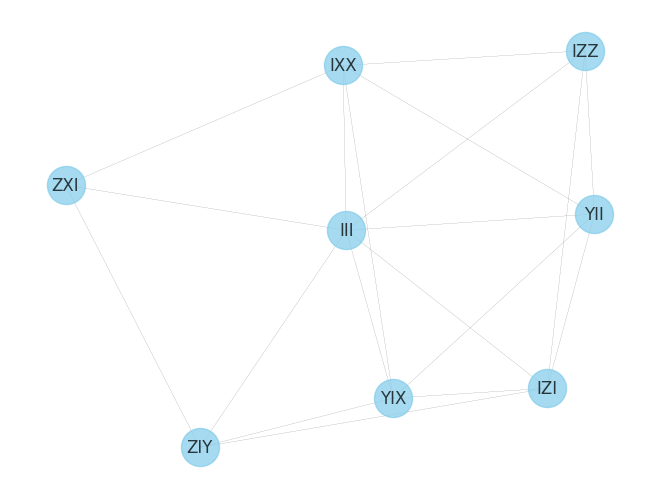
PauliwordOp also has graph functionality:
Nodes / Vertices are used to represent Pauli operators
Edges are used to represent a defined commutation relation between Pauli operators
op = PauliwordOp.from_dictionary({
 'III': (0.44635739706240757+0j),
 'IZI': (-1.3319405851037809+0j),
 'IZZ': (1.0470696736027791+0j),
 'ZIY': (-0.05713271668152262+0j),
 'ZXI': (0.8028744054919319+0j),
 'IXX': (0.24469102625407302+0j),
 'YII': (-0.3680101467816112+0j),
 'YIX': (1.2592176764100222+0j)})
import networkx as nx

Graph = op.get_graph(edge_relation='C', # <- can change to ['AC', 'QWC']
                     label_nodes=True)

nx.draw(Graph,
        with_labels = True,
        alpha=0.75,
        node_color="skyblue",
        width=0.1,
        node_size=750
        )
dict_of_cliques = op.clique_cover(edge_relation='C')
print(dict_of_cliques)
{0:  0.446+0.000j III +
-0.057+0.000j ZIY +
 0.803+0.000j ZXI, 1: -1.332+0.000j IZI +
 1.047+0.000j IZZ +
-0.368+0.000j YII, 2:  0.245+0.000j IXX +
 1.259+0.000j YIX}
Try the above functions, but change edge relation to one of:
C= Pauli operators in clique must commuteAC= Pauli operators in clique must anticommuteQWC= Pauli operators in clique must qubitwise commute
We can also get the generators for a Pauli operator. For example:
P = PauliwordOp.from_dictionary({
'III': (1+0j),
 'IIZ': (1+0j),
 'IZI': (1+0j),
 'IZZ': (1+0j),
 'ZII': (1+0j),
 'ZIZ': (1+0j),
 'ZZI': (1+0j),
 'ZZZ': (1+0j),
 'IIX': (1+0j),
 'IXI': (1+0j),
 'IXX': (1+0j),
 'XII': (1+0j),
 'XIX': (1+0j),
 'XXI': (1+0j),
 'XXX': (1+0j)})
has the following generators:
P.generators
 1.000+0.000j IIZ +
 1.000+0.000j IZI +
 1.000+0.000j ZII +
 1.000+0.000j IIX +
 1.000+0.000j IXI +
 1.000+0.000j XII
We can get the Hermitian conjugate of an operator by using the dagger
op = PauliwordOp.from_dictionary(
    {
        'XX':1,
        'ZZ':2 + 1j,
        'YY':3 - 4j
    }
)
print(op)
print()
print(op.dagger)
 1.000+0.000j XX +
 2.000+1.000j ZZ +
 3.000-4.000j YY

 1.000-0.000j XX +
 2.000-1.000j ZZ +
 3.000+4.000j YY
We can use this to show a Haar random unitary is in fact unitary:
n_qubits= 2
haar_random = PauliwordOp.haar_random(n_qubits,
                                disable_loading_bar=True)

haar_random * haar_random.dagger
1.000+0.000j II
We can get the Hermitian conjugate of an operator by using the dagger
op = PauliwordOp.from_dictionary(
    {
        'XX':1,
        'ZZ':2 + 1j,
        'YY':3 - 4j
    }
)
print(op)
print()
print(op.dagger)
 1.000+0.000j XX +
 2.000+1.000j ZZ +
 3.000-4.000j YY

 1.000-0.000j XX +
 2.000-1.000j ZZ +
 3.000+4.000j YY
We can use this to show a Haar random unitary is in fact unitary:
n_qubits= 2
haar_random = PauliwordOp.haar_random(n_qubits,
                                disable_loading_bar=True)

haar_random * haar_random.dagger
1.000+0.000j II
Attributes
Note the number of significant figures a Pauli operator is reported too by default is 3:
P = PauliwordOp.from_dictionary(
    {
        'XX': 0.0001,
        'ZZ': 0.0001j,
    }
)
print(P)
 0.000+0.000j XX +
 0.000+0.000j ZZ
in order to increase this we need in increase sigfig attribute:
P.sigfig= 5
print(P)
 0.00010+0.00000j XX +
 0.00000+0.00010j ZZ
We can also access the coefficients of each Pauli operator via the coeff_vec attribute
print(P.coeff_vec)
[0.0001+0.j 0. +0.0001j]
That returns a numpy array